It usually starts in the garden. A child freezes mid-step, points at a flower, and asks the question that launches a thousand lessons: “What is that bee doing?”
Congratulations, you’ve just been handed a week of free curriculum. Bees are one of the best homeschool topics we know for ages 4–9: they’re everywhere in summer, they’re genuinely dramatic (dancing! architecture! a queen!), and they connect to almost every subject without forcing it. Here are seven honeybee activities that turn that garden moment into real learning, and how to stitch them together into a full unit study if the obsession sticks.
1. Take a bee-watching walk
Start where the curiosity started: outside. Pick a sunny morning, find some flowers, and just watch, from a respectful few feet away. Count how many flowers one bee visits before it flies off. Notice the yellow dust on its legs. Young scientists don’t need a worksheet for this one; they need ten quiet minutes and someone to wonder along with them. (“Where do you think she’s taking all that pollen?”)
Bees at flowers are working, not defending. They have no interest in your kids. Watching calmly from a few feet away is both safe and the whole point: this is how real entomologists start.
2. Build a bee water station

Here’s a secret most grown-ups don’t know: bees get thirsty, and deep water is dangerous for them. A shallow dish, a handful of pebbles for landing pads, and an inch of water makes a genuine bee rescue station, and a daily observation post your kids will check like a nature documentary. Refill it together each morning and you’ve quietly built a responsibility routine, too.
3. Do the “why is honey so thick?” experiment
Put a spoonful of honey and a spoonful of water side by side on a plate and tilt it. Which one races? Which one crawls? That’s viscosity, a real science word your 6-year-old will happily deploy at dinner. Then test other kitchen liquids (milk, syrup, dish soap) and rank them from fastest to slowest. It’s a complete science lesson with zero shopping required.
4. Count like a honeycomb
Bees are mathematicians: every honeycomb cell is a perfect hexagon, because hexagons tile with no wasted space. Draw a honeycomb grid and let little ones count and color cells; older kids can figure out rows-times-columns (“3 rows of 4 cells… how many all together?”) which is multiplication sneaking in the back door, dressed as a beehive.
5. Play the waggle-dance game
When a honeybee finds good flowers, she tells the hive by dancing: the direction and length of her waggle is a map. Hide a “flower patch” (a snack works beautifully) somewhere in the yard and have one child silently dance directions to the others. It’s giggly, it’s wiggly, and it plants one of the most wonderful facts in nature: bees talk with their bodies.
6. Collect bee words like pollen
Keep a “hive vocabulary” card stack going all week: pollen, nectar, hive, colony, queen, waggle, pollination. One new word a day, traced or written and said out loud at dinner. If your early writer wants to stretch further, our free Stretch a Sentence printable turns “A bee.” into “In the morning, a fuzzy bee zoomed to the sunflower to drink nectar.”
7. End with a build-a-bee finale

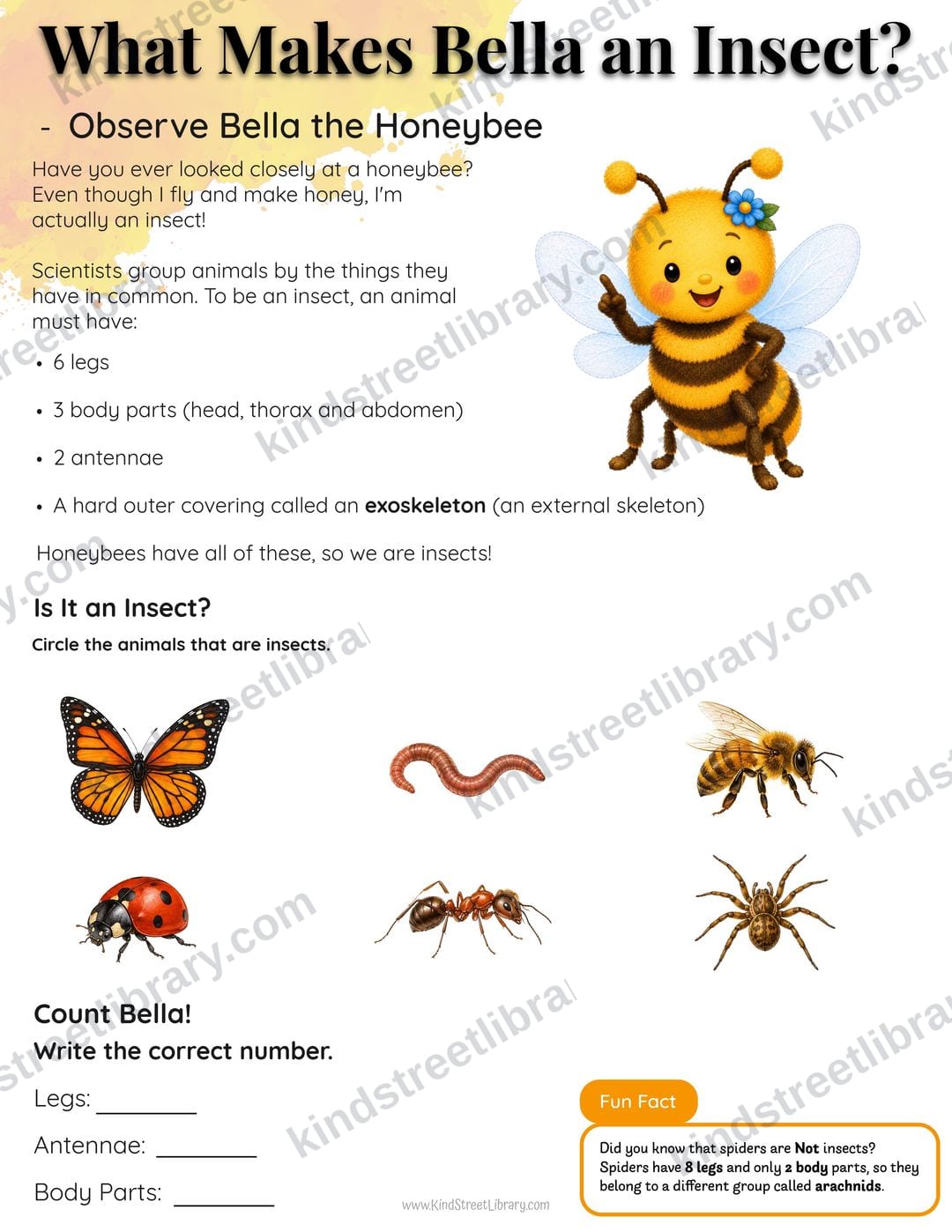
Every unit study deserves a show-and-tell ending. Draw and label a bee (head, thorax, abdomen: three body parts is the “am I an insect?” test), build one from craft supplies, or have your child teach the family one amazing bee fact at dinner. (Ours was: a worker bee makes about 1/12 of a teaspoon of honey in her whole life. Nobody at our table has wasted honey since.)
Stitching it into a full unit study
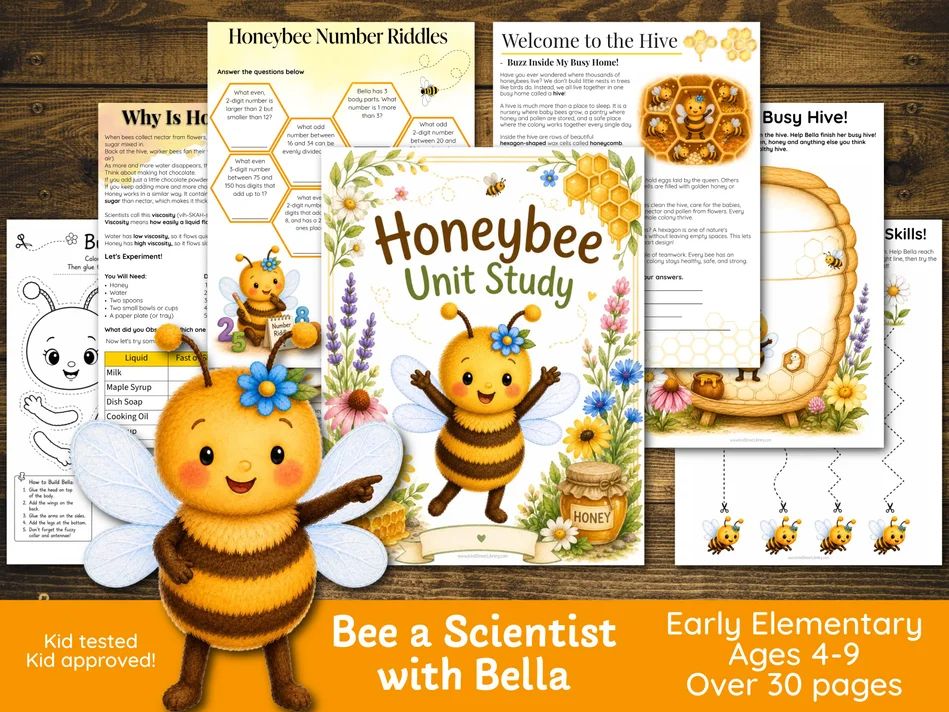
Any three of these activities make a lovely week. But if your child is truly in it (asking bee questions in the bathtub), that’s the moment a done-for-you study earns its keep. Our Bee a Scientist with Bella honeybee unit study takes everything above and turns it into over 30 print-and-go pages guided by Bella the Honeybee: hive science and pollination reading, honeycomb math and number riddles, bee vocabulary and silly fill-in stories, the viscosity experiment and water-station directions, crafts, coloring, and a Certificate of Completion for your new little bee scientist.
It’s built the way all our studies are (one topic, every subject growing out of it), and it flexes for siblings, so a 4-year-old colors the honeycomb while an 8-year-old works the arrays. (Here’s how one study carries two ages at once.)
Frequently asked questions
What ages are honeybee activities best for? The sweet spot is ages 4–9. Littles get counting, coloring, and the wonder; older elementary kids get real vocabulary (viscosity! pollination!), multiplication-style honeycomb math, and hands-on experiments. Most of the activities above flex a level up or down without any changes.
Are bee activities safe for kids who are scared of bees? Yes, none of these require touching or approaching bees. Watching from a few feet away, building a water station, and the kitchen experiments are all hands-off, and learning how bees actually work is one of the most reliable cures for bee fear we’ve seen. (Do skip the bee walk if anyone in the family has a sting allergy, and enjoy the indoor activities instead.)
How long should a honeybee unit study take? A week is perfect: one activity a day, twenty to forty minutes each. Our honeybee unit study is built as 5 lessons for exactly that rhythm, but there’s no timer. Some families stretch it across two gentle weeks of summer.
Do I need special supplies? No. Everything above uses what you already have: a shallow dish, pebbles, honey, a spoon, paper, and crayons. The unit study is a digital PDF you print at home.
However you run it, keep the finale in sight: a kid who spends a week with the bees stops seeing a scary buzzing thing and starts seeing the tiny worker keeping the garden alive. That shift, from fear to wonder to care, is the real lesson. 🐝