There is a particular kind of homeschool day worth aiming for. Your child wakes up already thinking about the thing they love. Today it’s octopuses. They want to know how many arms, how they hide, what they eat, and whether one could really open a jar. You don’t have to invent motivation or bribe anyone to sit down. The curiosity is already there, buzzing, and your job is mostly to give it somewhere useful to go.
That’s the promise of an interest-led unit study. Instead of five separate subjects that feel unrelated to each other and to your child’s actual life, you take one topic your child already cares about and let it carry reading, writing, math, science, and art for a week. The learning sticks because it’s attached to something real. And the week feels less like herding and more like following.
This isn’t about travel or a special program. It happens at your own kitchen table, with the fascination your child brought home on their own. The rest of this post is the practical part: exactly how to build that week, step by step.
Start with the obsession you already have

You don’t need to choose a topic. Your child already did. Listen for the animal that keeps coming up: the one they draw, the one they ask about in the car, the one they’d talk about all through dinner if you let them. Sharks, wolves, honeybees, sea turtles, hummingbirds, dinosaurs, house cats. Any of these can anchor a full week.
Write the animal at the top of a blank page. Underneath, jot down three or four questions your child has actually asked, in their own words. “How does it sleep?” “Why is it that color?” “How big does it get?” Those questions are your lesson plan in disguise. They tell you what your child is ready to learn, which is far more useful than a topic you picked because it seemed educational.
One animal is plenty for a week. Resist the urge to cover the whole animal kingdom. Depth on one creature does more than a shallow tour of ten.
Map the topic across the five subjects
Here’s the move that makes a single animal cover a whole week. Take your one topic and ask what each subject can pull from it. Look for the connections that genuinely fit rather than forcing boxes to check.
Reading: Gather a small stack from the library, a picture book, a nonfiction title with real photos or illustrations, and one story that features the animal. Read together and let your child follow along at their level.
Writing: Have your child write or dictate what they learned. A younger child might label a drawing or copy a few key words. An older child might write three facts, a short description, or a made-up story starring the animal.
Math: Numbers hide inside every animal. Count, measure, and compare. How long is a shark compared to your hallway? How many eggs does a sea turtle lay? Use tally marks, simple graphs, or a measuring tape on the floor.
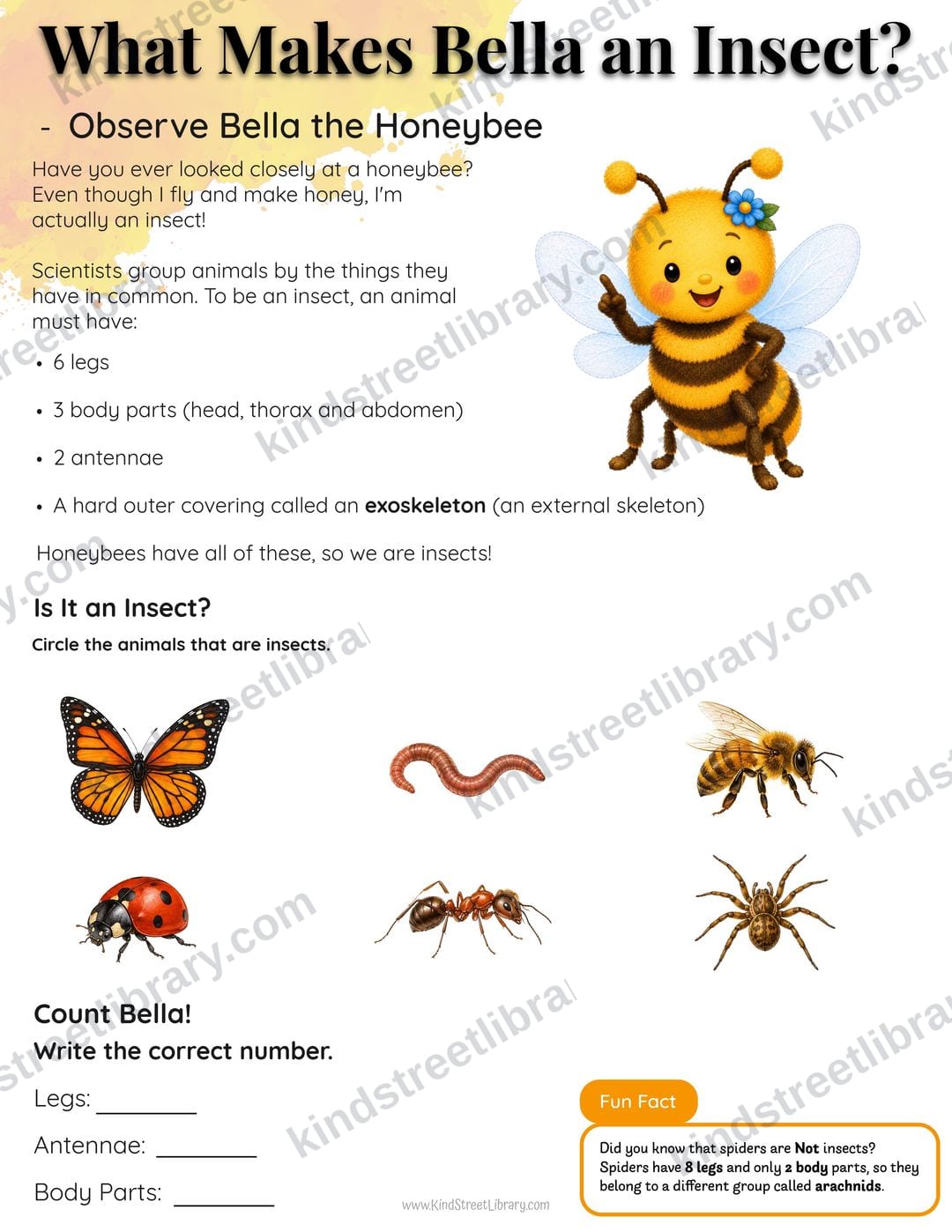
Science: This is the heart of it. Habitat, diet, body parts, life cycle, and how the animal survives. Observe, ask questions, and look up real answers together.
Art: Draw the animal, paint it, sculpt it from playdough, or build its habitat from a shoebox. Art helps a child slow down and truly see the details they’ve been reading about.
Jot one small idea under each subject. That short list is your week.
A sample five-day plan you can copy

Here is one way the week can flow. Adjust the pace to your child. Some days run long because the interest is high, and some days a single activity is enough. That flexibility is a feature of learning at home, not a failure of planning.
Day one, meet the animal. Read the nonfiction book together. Start a simple fact chart with columns for what it looks like, where it lives, and what it eats. Let your child ask everything they want.
Day two, science focus. Look closely at how the animal survives, its body, its habitat, and its life cycle. Add new facts to the chart. If a safe, simple observation fits, like watching how a real backyard bird moves, do it with an adult nearby.
Day three, math day. Measure and compare. Line up the animal’s real length against objects in your home. Count something countable and make a small graph or tally.
Day four, writing day. Your child writes or dictates what they’ve learned so far. Younger children label a drawing; older children write a few sentences or a short story.
Day five, art and share. Draw, paint, or build the animal or its home. Then have your child teach the family one thing they learned. Explaining it out loud is one of the strongest ways to make learning stick.
By Friday, your child has read, written, measured, observed, and created, all around the animal they chose.
What you need on hand (and what you don’t)
You can run this week with what most homes already have. A stack of library books, paper and pencils, crayons or paint, a measuring tape or ruler, and a little space to spread out. A shoebox and some scrap materials cover the art project. That’s the honest list.
You don’t need a boxed curriculum, a laminator, or a budget. You don’t need to be an expert on the animal either. Part of the point is learning alongside your child and modeling what it looks like to find an answer you didn’t already know. When a question stumps you both, that’s a good moment, not a gap. You look it up together.
A quick safety note for the science and art pieces. Keep an adult nearby for scissors, any outdoor observation, and small parts with young children. Choose household-safe materials, and skip anything that involves handling wild animals directly. Watching, drawing, and reading give you plenty.
How to keep it flexible and low-pressure
The biggest mistake with interest-led learning is turning it back into a rigid checklist. If your child wants to spend two days on shark teeth and never gets to the art project, that’s fine. They were reading, counting, and thinking the whole time. The subjects were still there, just not in the order you wrote them.
Let the child’s questions steer the pace. When interest is high, follow it. When it fades, you can wrap up early or set the topic aside for another week. Not every page has to be finished, and not every activity fits every child. A four-year-old and an eight-year-old can share the same animal at very different depths.
Forget the perfect week. The goal is a child who learns that their own curiosity is worth following, and who starts to see that reading, math, science, writing, and art aren’t separate chores. They’re just different ways of getting to know something you love. That habit, the drive to teach yourself about the things that fascinate you, is the kind of thing that keeps going long after the week is over.
Ready to build your own week
The next time your child gets stuck on an animal, treat it as an invitation rather than a distraction. Grab a blank page, write down their questions, pull a few books, and map the five subjects onto the one topic they already love.
If you’d like a running start, our unit studies are built on exactly this approach, one topic carried thoughtfully across subjects with real factual depth, clear parent setup, and activities that fit ages four through nine. They’re designed to save you the planning while keeping the learning grounded and useful.
Either way, the most important ingredient is already in your house. It’s the child who won’t stop talking about frogs. Follow that, and the week mostly plans itself.