Every year around the end of June, some small person in your house looks up from the sidewalk chalk and asks the question: “Why do we have fireworks?” And every year, a lot of us answer with some version of “um… freedom?” and then quietly hope they don’t ask a follow-up.
This is the post I wish I’d had on my first homeschool 4th of July. Here are seven hands-on Independence Day activities for kids ages 4–9, the kind you can actually pull off between cookouts, that sneak real learning in sideways, and that leave your kids with a better answer than “um, freedom.”
What is Independence Day, in kid terms?
Before the activities, the short version you can say out loud at the breakfast table: Independence Day is America’s birthday: the day, back in 1776, when the people living here decided they wanted to make their own rules instead of being told what to do by a king far across the ocean. They wrote it all down in a letter called the Declaration of Independence, and we’ve been celebrating that brave decision with flags, parades, and fireworks ever since.
That’s it. For a four-year-old, “America’s birthday” is plenty. For an eight-year-old, the fun is in the why, and that’s where these activities come in.
7 hands-on 4th of July activities for kids

1. Write your own declaration. This is the one my kids ask to do again. Give them a piece of paper (tea-stain it for drama if you’re feeling fancy) and let them declare something they believe: “I declare that ice cream counts as dinner.” Then everyone signs it, big and loopy, like John Hancock. You’ve just taught what a declaration is without a single worksheet.
2. Build a flag and talk about why it looks that way. Count the stripes (thirteen, for the first thirteen colonies). Count the stars (fifty, one per state). For little ones, that’s counting practice and a real conversation hiding inside a craft.
3. Run a “spread the news” relay. In 1776 there were no phones. Big news traveled by rider, by ship, by word of mouth. Whisper a “headline” to one kid and have them carry it across the yard to the next. It gets gloriously garbled, which is the whole point: it’s a giggly way to talk about how hard it was to share news back then.
4. Do fireworks math. Sneak in a few story problems with the holiday baked right in: “There are 8 sparklers in the box and 3 cousins. How many does each get? Any left over?” Math always lands better when it’s about sparklers than about nothing in particular.
5. Paint fireworks (the no-fire kind). Dip a fork or a toilet-paper tube cut into fringe, press it onto paper, and let the bursts overlap. Fine-motor practice for the four-year-olds, color-mixing for the older ones.
6. Read the story of the Boston Tea Party. Kids love this one: grown-ups dumped an entire harbor’s worth of tea into the water to protest a rule they thought was unfair. It’s the perfect doorway into a big idea: people can disagree with a rule, and there are brave and not-so-kind ways to do it.

7. End with a “good neighbor” conversation. Independence isn’t only about a country. It’s about people learning to live together well. Over the cookout, ask: “What’s one rule in our family that’s fair? Is there one you’d change?” You’ll be surprised what a six-year-old has been thinking about. (If that one catches fire, here are 10 kindness conversation starters to keep the good talks going all summer.)
Make it a learning week, not just a day
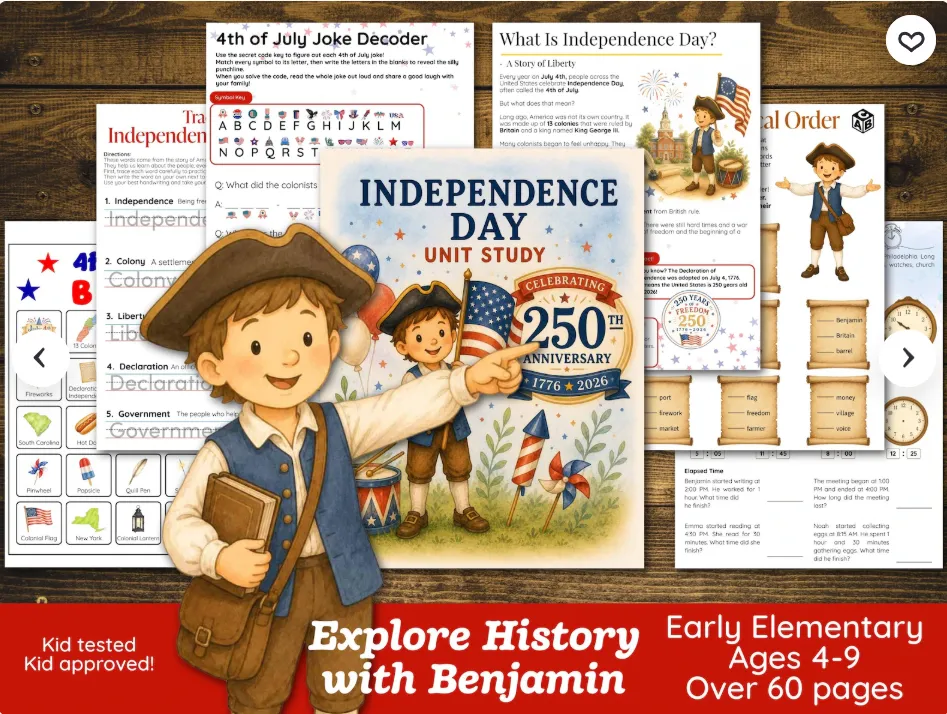
Here’s the gentle truth: you do not have to invent all seven of these from scratch on July 3rd at 9pm. That’s exactly why we built Benjamin’s Independence Day unit study. It’s the whole week, printed and ready: the story of 1776 told simply, July 4th word problems, a make-your-own declaration to sign, a silly fill-in-the-blank grammar story, flag studies, and citizenship conversations, all hosted by a friendly colonial kid named Benjamin. Over 60 pages, no prep, made for ages 4–9.
Whether you DIY the list above or print the study, the idea is the same one we believe about all our unit studies: pick one thing your kids are already curious about, and let every subject grow out of it. One topic, many doors in.
Frequently asked questions
What are good 4th of July activities for preschoolers? Keep it to the senses and the hands: paint fireworks with a fork, count flag stripes, wave a homemade flag in a living-room parade. A three- or four-year-old doesn’t need the history yet: “it’s America’s birthday, and we’re celebrating” is exactly enough.
How do you explain Independence Day to a 5-year-old? Use the birthday frame: a long time ago, the people here decided they wanted to make their own rules instead of a faraway king making them, so they wrote it down and we’ve celebrated ever since. Five-year-olds understand fairness and “making your own choices” deeply. Anchor it there.
How long should a 4th of July unit study take? For ages 4–9, a week is plenty: one activity a day, twenty to forty minutes each. You can also do the whole thing in a relaxed afternoon. Short and joyful beats long and dutiful every single time.
Do these work for mixed ages? Yes, that’s the beauty of a unit study. The same activity flexes: a four-year-old counts the stripes while an eight-year-old reads the Boston Tea Party page and writes a real declaration. Same table, same topic, different depths.
So when the sidewalk-chalk question comes this year, you’ll be ready. Not with “um, freedom,” but with a fork full of paint, a homemade declaration, and a kid who actually knows why we light up the sky. 🇺🇸